The purpose of the use of census data is to identify the most promising, and conversely the least promising, areas where NJB chapters can be formed. In general we are looking for traditional families in upper and middle class neighborhood clusters where at least three in five parents have achieved having a college degree and where a high percentage of parents hold professional, technical, and managerial positions. Ethnically these tend to be White and Asian neighborhoods where incomes are significantly above average. In the Bay area that threshold is an average household income above about $130,000 for any given zip code, while in Sacramento we will look for a more modest $100,000 given the generally lower standard of living. A parallel indicator is local school ratings, which correspond very closely to participation rates as well.
The initial analysis of the region from census data reveals, not too surprisingly a ring of higher income housing with traditional families around the Folsom lake, particularly in the cities of El Dorado Hills on the south shore and Granite Bay on the north shore, with Folsom not quite as exclusive in the middle. There is also a nearly contiguous belt of well to do housing pockets along the shore of the American river almost to the Sacramento city limit. This should not be surprising as most people when they can afford to do so prefer to live by the water front or in the foothills. Finally middle class family neighborhoods are found in Roseville and Rocklin in Placer county, where a significant amount of industry is present just north of Interstate 80. I crunched the numbers children in grades 3-8 and applied a variant of the predicting formula used for Silicon Valley region to estimate the number of players a zip code might produce it resulted in the map below. Note, blue indicates Household incomes over $100,000, and in some cases above $130,000 while red indicates those below $60,000 (note, several zip codes were below $30,000 per household).

There are two zip codes in the city of Sacramento that indicate some potential and both deserve some commentary. The first is zip code 95818 situated near the Marina, and is a split personality demographically. It has the most troubled school in the entire Sacramento region, Leataata Floyd Elementary, which list 100% of the students as disadvantaged, and the household income is a mere $10,000 a year for those who live closest to the school, and less than $26,000 for those more periphery. And yet it also has the best performing neighborhood school in the entire Sacramento City District, Crocker/Riverside, that is full of middle class students and high income parents ($120-145,000 averages). Unfortunately this Marina are neighborhood is not close to any other NJB ready neighborhoods. The second zip code is 95819 which turns out to be the area immediately surrounding CSU Sacramento. It turns out to be a statistical fluke, high income for many non-family households, with however a magnate school. Both zip codes predict about two dozen NJB players, but upon examination only the first one might actually yield some players, although they would have to travel to one of the suburban chapters.
Suggested Chapters:
None of the three communities identified as strong candidates is especially large. And arguably they make up one single community around the Lake. However there is a natural way to divide them such that the number of communities and children served can be maximized, which is by county lines. This would create three chapters with three different sets of school districts:
1) El Dorado NJB would take the very high end community of El Dorado Hills and incorporate neighboring communities of Cameron Park, Shingle Spings;El Dorado Chapter:
2) Placer (County) NJB would be centered on the communities of Granite Bay, Roseville, and Rocklin;
3) American River NJB [2] would be based on the city of Folsom and San Juan Unified school district, incorporating the belt of family neighborhoods of Gold River and Arden-Arcade.
The El Dorado chapter is similar in size and demographics to the Los Gatos chapter. That this is the correct division shows up in the estimates for the number of players. El Dorado projects around 240 players, but this is almost certainly low given the demographics - it is similar in make up and size to the Los Gatos NJB chapter. And indeed that appears to be the case as the El Dorado Hills Youth Basketball league (EDHYB), which is a private league run along similar lines as NJB and covers the same territory as I propose, fields 44 teams (10 D1 boys, 4 D1 girls, 12 D2 boys, 4 D2 girls, 10 D3 boys, 4 D3 girls; they also have 8 HS teams). It is a one weeknight practice and Saturday game league which occupies the local gyms. What they lack are All Stars, All-Net, and non-local games. This group is well established, parent run and deep board, has a very high community buy in and participation, which in my opinion makes it unlikely to be displaced by NJB. Absorption or acquisition is probably the better strategy to undertake, perhaps starting with a Saratoga like model of split levels, one continuing as recreational (Saturday games) and the other NJB (Saturday 2nd practice, Sunday games).
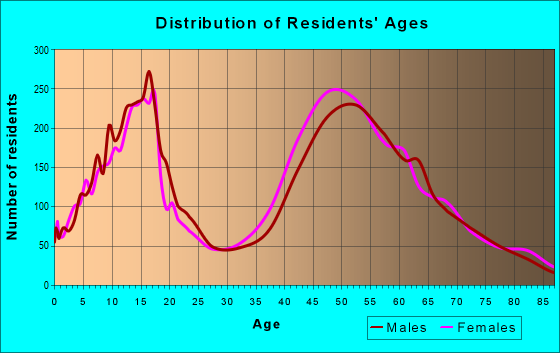 |
| Age Distribution of Granite Bay Residents |
Placer County demographics projects to support a chapter of 330-360 players. This is an area with a decent High School sports reputation, and plenty of facilities with a half dozen high schools and Sierra College. It is also surprisingly compact geography, with the communities of Granite Bay, Roseville, Rocklin, and Loomis completely contained within a radius of 4 miles at the junction of I 80 and CA 65. It should be noted this is virgin territory for NJB, as my web search revealed not a single active youth Basketball league, nothing from the Roseville or Granite Bay recreation departments. This chapter is going to have to lean heavily on Granite Bay for leadership, given it is the only city where most of the adults graduate from college (52%, and an exceptional 21% hold graduate degrees, doubling every city except El Dorado Hills), and is the closest to a bedroom traditional family community (note the classic double peak of age groups we see in traditional family neighborhoods with high income and high education levels for parents). The chances for success should be very good, as the demographics somewhat resemble the West San Jose chapter, which is roughly the size the numbers project.
American River Chapter:
The third chapter in east Sacramento county's suburbs is more problematic. The culture is present in Folsom for youth Basketball, as witness the established Folsom Youth Basketball Association (FYBA) which serves as the local recreation league. (Note, it is curious that there seems to be a complete lack of city run leagues in the region for youth.) There does seem to be pent up demand beyond Folsom as FYBA spends some space on their web page devoted to the wait list status of non-Folsom residents. But Folsom is simply not large enough a population base, given the demographics, to support a full program NJB chapter, as it projects to 110-120 players only for an NJB style program. The local established culture might push that number up a few dozen, but no more. A more realistic chapter should incorporate Arden Arcade and pick up pockets along the American River in Carmichael, Fair Oaks and Gold River. This layout can be seen in more detailed map below of the region shows the distribution of neighborhoods in purple where NJB is more likely to succeed.
 |
| Distribution of Higher income (above $100,000 per household) traditional families with Children by census sub-block |
Elk Grove NJB:
The NorCal website indicates there is an effort to start a Sacramento section, starting with a chapter in Elk Grove. While this is not the spot I choose first to start a Sacramento Section, as a quick look at the city data for Elk Grove and neighboring Vineyard indicates only modest potential for sch a chapter. While the population of Elk Grove is 167,000, the majority are lower income. But the towns do including many residential neighborhoods which are well enough off that my models projects ten tow twelve teams could be had, less than half the size of a self sustaining chapter needs. However if we expand the chapter to at least include the entire Elk Grove Unified School District, picking up in the process Rancho Murieta and parts of Rancho Cordova the viability of the chapter is significantly improved. The map of the district's schools shows that the southern and western portion of the district, running along Grant Line Road, extending a bit north into the western part of Vinyard, show the higher ranking schools which tend to fit the family community which might support youth sports. Indeed if the boundaries are set up as the school district, then the projected size of the chapter is around 180 players. [3] Elk Grove would be a fine 4th chapter
Davis Chapter:
The college town of Davis lies to the west of Sacramento and is something of a high income oasis. The schools are extremely good, and there is a surprisingly large number of families with children in school. This could form a small Hollister or Morgan Hill type chapter easily, with plenty of facilities, volunteers, and money to operate. The numbers are likely to only be around 100 players, but to work the Sacramento section would be greatly helped by these additional teams.
The resultant division into creates a chapter boundary map that looks something like this, using school district boundaries and county lines for the five proposed chapters, to give a clear picture.
 |
| Sacramento Chapters: Davis, Elk Grove, El Dorado, Placer, American River |
NJB for all intents and purposes is a suburban product. It has been most successful where a deep supply of high achieving parents with white collar managerial and operational skills are available to fill board roles. When these are missing NJB chapters struggle, needing a hero to keep them going, as we have seen in urban, and blue collar urban areas.
New Urban Strategy:
For penetrating more urban areas, even where the athletic tradition is strong has proven a challenge NJB has not yet mastered, and in fact has failed utterly. Clearly NJB needs a new strategy, one which is basically limited in scope and both supported and run at the section level. This strategy would focus on an All-Net and AAU program plus camps, where the section would "tax" suburban chapters a small fee per team to build up a fund to support it. Sacramento/West Sacramento, and Daly City/South San Francisco are two areas that are prime to test that theory (after establishing the suburban chapters outlined above, and after a Burlingame-San Mateo chapter is up and running in Silicon Valley). This strategy requires some greater thought and discussion before launching a test case such as Daly City or West Sacramento.
In Summary:
For the Sacramento region the goal would be to set up the Placer county chapter and to build the east Sacramento county chapter while trying to negotiate the absorption of the El Dorado Hills Youth basketball league into the NJB banner. With three solid chapters to provide an ecosystem, the Elk Grove chapter could also get off the ground. Davis would complete the loop, wit a Hollister sized chapter. The challenge would be to field at least 4 All-Net teams at grade 6th through 8th for Boys initially, and if possible for girls at any age level, probably focusing on the 7th grade. This is where the urban strategy comes into play, to try and built a team from Sacramento itself for each level, then inviting a couple AAU clubs to fill a 6 team at each level, and have a 10 game double round robin schedule. But all these things require getting the three Folsom Lake based chapters up and running.
Notes:
[1] I do have relatives in Loomis and my wife has some in Fair Oaks, near the American River. And I have had occasion with my work and for my son's sports activities to visit. But I never looked beyond a few restaurants and things like the Capitol building.
[2] I designated the chapter "American River" although there are many other possible names. Natoma is the name of the recreational man made lake of the upper American river, and could be a suitable name. Gold River is also a nickname of the American.
[3] It should be noted that when there are many players in close proximity they tend to pull their friends in. Zip code areas which should produce 30 players on paper, often yield far fewer because those who fit the profile may be scattered, with only two or three candidates in a given elementary school, or are part of a culture that does not emphasize youth sports participation. On the flip side, certain communities, such as Los Gatos, the Rose Garden, San Carlos, and Los Altos, which have a high participation rate tend to pull in many more children than models would suggest as a result. A similar critical mass effect can be seen for Campbell Little League Baseball. This critical mass point is not identified here due to insufficient data. Note, critical mass seems to have been met in the communities of El Dorado Hills and Folsom for their local youth basketball leagues.

No comments:
Post a Comment